
TOWARDS THE UNKNOWABLE: CLARE GATTO AND KARA GÜT
By Isabella Nimmo

Isabella Nimmo: I want to start by asking if you can both speak to your independent practices and the points at which they intersect?
Kara Güt: My work deals with our intimate experiences with and within digital space, and how we use digital space as both a tool of mediation between relationships, but also an unburdening from physical constraints. I take this dichotomy of digital space and turn it into performance, video, image, or sculpture. I use software and technology as raw material, breaking or hacking or modding to mine a new and unintended creation. I’ve found that my practice has a lot of overlap with fandom and fan culture. When I’m making my interventions in software or media, I think of it in terms of a fan interacting with their source materials. The fan, the consumer, the hobbyist, investigates a material for the love of that material, and makes interventions in an intuitive way, which I relate to very much. Maybe I found a comment on an abandoned forum, or a video of a speedrunning exploit that I then try to replicate and turn into a performance.
Clare Gatto: A lot of my work involves thinking about what it means to reach the edge of a thing. I’m interested in learning what happens when you press up against something’s boundaries: is it fluid?
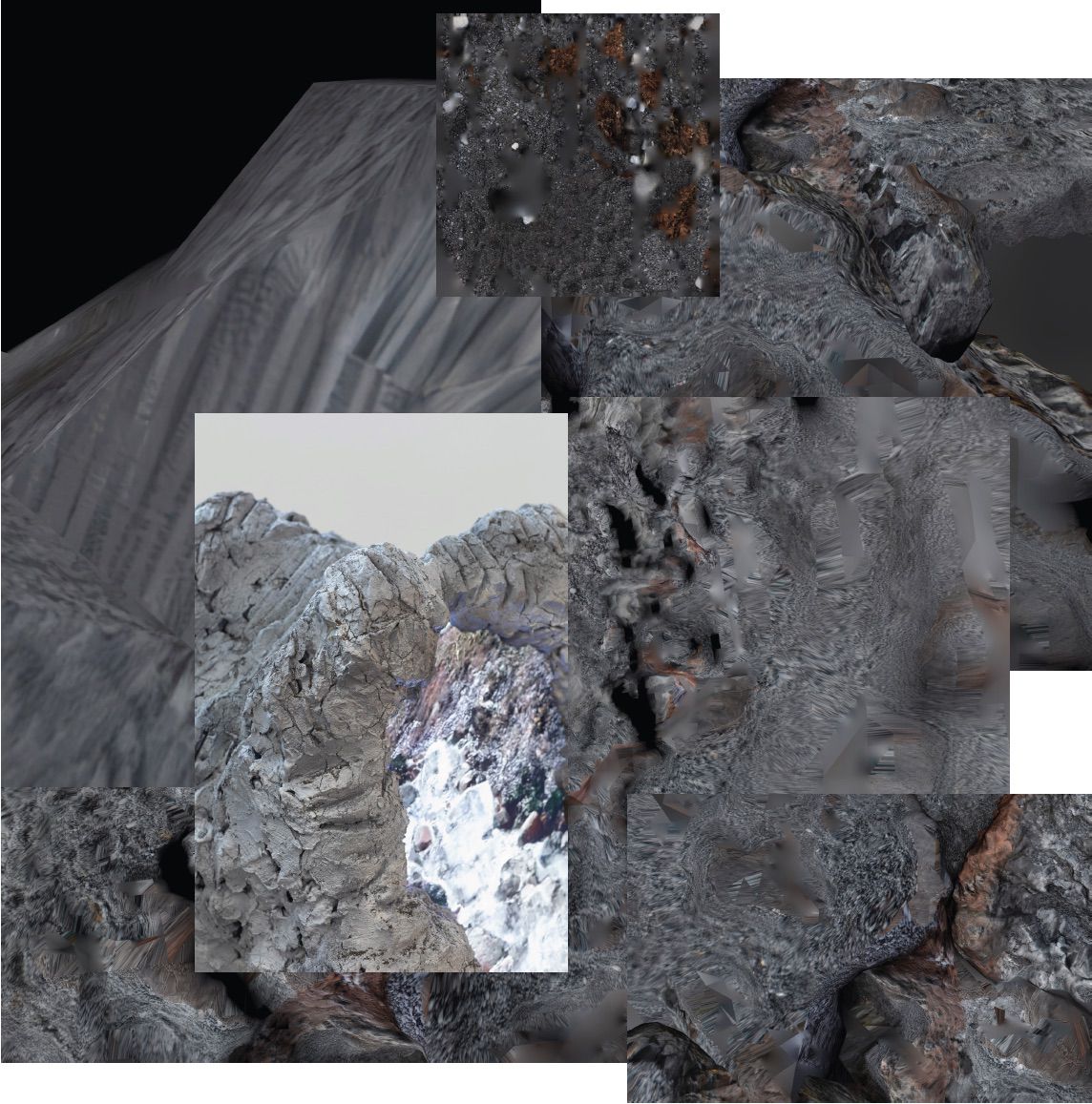
Is it fixed? Is it a cloud? What is that space that’s both knowable and unknowable? To do this I use photogrammetry, a photo-based 3D scanning technique, to probe the nuance of bodily constitutions. Through the use of software, I playfully exploit the boundless opportunities of virtual space to emulate the mysterious aspects of mutation and adaptation that take place on cellular and quantum levels. The resulting scripted, fictionalized bodies, tissues, and landscapes take an immutable and illegible form. They evoke a body, but refuse to delineate boundaries, scale, or relationship to other forms in their proximity. This work is very much influenced by writings on queer failure and abstraction.
Like Kara, I also love to misuse technology within my process. I began using 3D scanning software by playing around with phone apps, such as Polycam. I then got more into the technique, mostly as a way of understanding how to break it more effectively. I’m never really going for an accurate translation, and by that I mean a realistic digital copy of a physical thing. That’s because I am interested in the sort of boundlessness that exists within speculative world building and world breaking; in the act of finding or looking and the potential that exists within the unknowable.
Kara and I have worked together for so long and come out of the same pedagogy or education. We met in college, during our sophomore year in a studio photo lighting class at Ohio State, and ended up going to grad school together for our MFAs in Photography. We found we think about things in a similar way; often both using the same tools, whether it be a specific camera or digitally generated images, but going about it differently. I sometimes think about Kara and I as if our work is two sides of the same coin; approaching the same tools, questions, or discourse from different angles.
Isabella: I’d like to go deeper into the tools and techniques you use. I’m wondering if you could further describe your process of exploring the “unknowable,” and how you define the term “strategies of input output,” which you’ve previously used to describe your process?
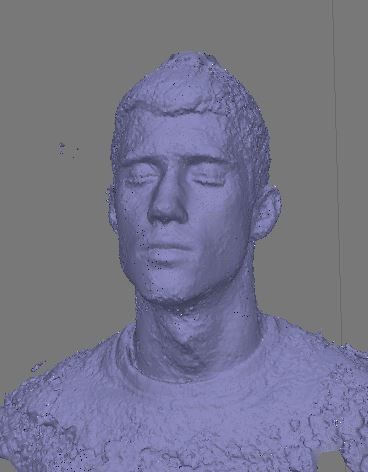
Kara: “Strategies of input-output” is a term we use to explain our process and the way we utilize technology. I think that entering information into digital space is inherently a transformative act. Information is translated and recorded, such as a stitched group of images from photogrammetry, or the scanned textures of rock or water, and transformed into pixels or point clouds or bump maps. By manipulating that material, collaging it, stretching images over polygons, that original information is iterated and distorted until, at times, it becomes unrecognizable from its source. Then, a final transformation occurs: the translation back into physical space, or the “output,” in the form of prints, sculpture, or installation. That process begins again once we recapture the sculptures and prints back into digital space to be iterated upon again.
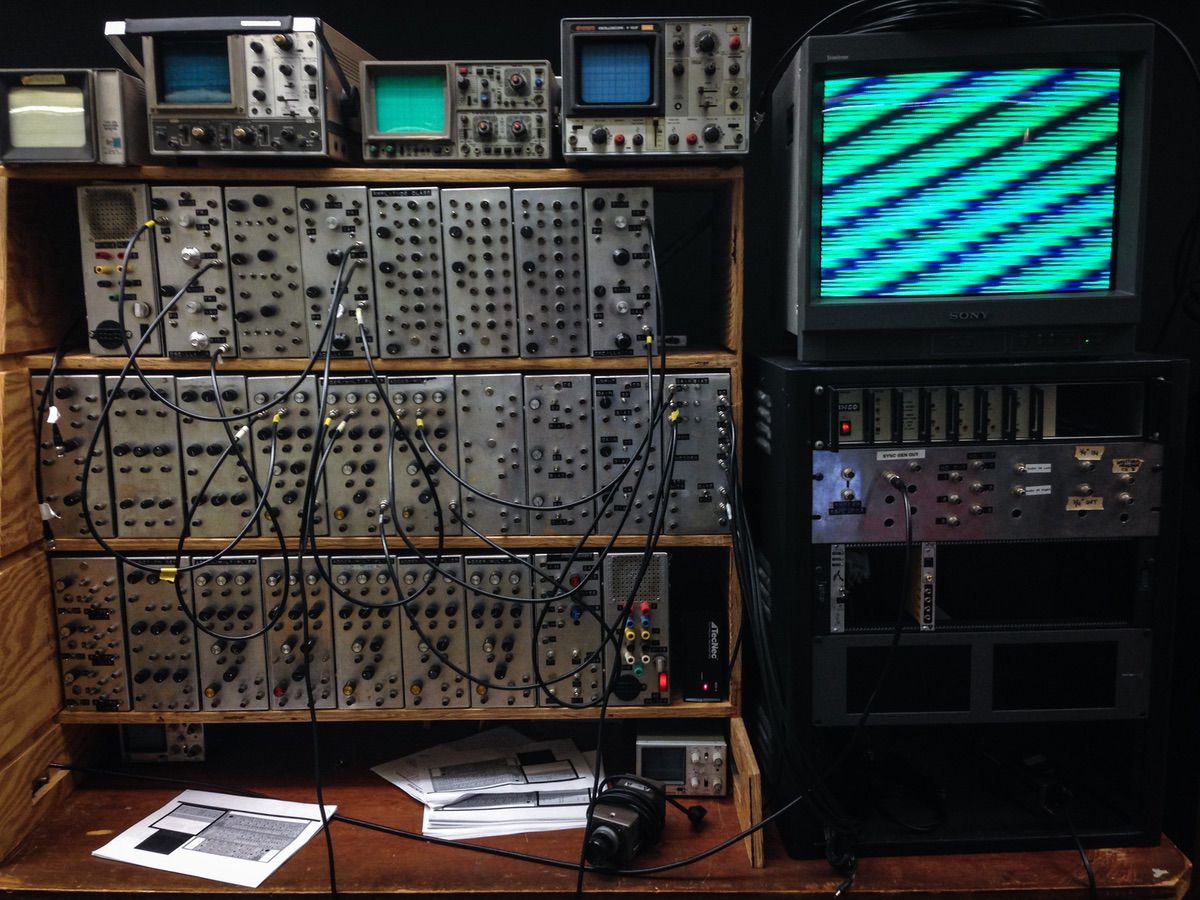
Clare: The main tools that we have been using for “digital input and output” are photogrammetry and sculpture. We were lucky enough to be artists-in-residence at the Institute of Electronic Arts at Alfred University in New York. During our time there we started exploring a more analog way of making with a video synthesizer called the Sandin Image Processor. If you are more familiar with audio synths, it is sort of like a Moog. If you aren’t familiar with synthesizers at all, to picture the Sandin, imagine an old fashioned telephone switchboard, but instead of phone lines, they are different video channels and aspects of the video, like the color, that we physically connect or disconnect with chords and dials.
The Sandin allowed us to use our 3D-generated videos as the input and then remix, layer, and edit the videos in real time. This experimental way of physically looping the digital inputs and outputs, in a sort of crazed loop, offered us a new sense of play and allowed us to discover what works for us rather than what this video synthesizer is “supposed to do.” A lot of the video works that you see in this exhibition were made with this synth.
Isabella: I don’t want to impose terminology as I think that’s besides the point of this project, but
there appears to be a lot of overlap in the way theorists of “glitch art” are thinking through the misuse of technologies or technical faults as an aesthetic device, as well as a political or conceptual one. I’m wondering if you could speak to this use of the “glitch,” or whatever terminology makes most sense to you, and its conceptual intention within your practice?
Clare: Yeah, “glitch” has become a genre in and of itself and it’s a very specific type of art. Our work can incorporate glitch and there’s definitely overlap with Glitch theory. We grew up alongside the emergence of the glitch aesthetic in the 2010s, and works such as Legacy Russell’s Glitch Feminism have been highly influential to us. But the terms we prefer to apply to our own work include the “misuse” of tech, and more so, “hacking,” but in the conceptual rather than technical sense. We’re misusing and hacking technology as a means of pushing it to its breaking point. Kara also uses the term “fan practices” a lot here, which is when a consumer is intentionally misusing and pushing products to create something new. I often use the term “queering” and think about the dichotomy between expectations versus limitations. I’m currently working on a project within my personal practice, where I’m trying to 3D scan fish and water. It’s an impossible task as photogrammetry isn’t intended to 3D scan something transparent. I see it as a form of “queering” the tool, or “misusing” the tool, for the sort of output that we want and working towards something undefined: an upending of the logics of the system.
Isabella: What is it that draws you to the video game or games in general, and by that I also mean ideas of play, within this broader series of installations? What purpose does the video game serve?
Kara: I think it’s great that you brought up play. I think that’s where our practice diverges from the genre of glitch. Play invites the viewer into the work, into the conversation. Going back to the idea of speculation, and moving towards the “unknowable,” there’s something powerful about leaving room for the viewer’s imagination. And this is where play comes in. It requires active participation, and brings the viewer into the discussion; to be involved, to imagine. It brings them into that quest for the unknowable, into the search for “the edge of a thing,” like Clare says. Leaving something inherently unfinished invites play, invites the audience to take part; to help complete the dream.
The video game, for us, was always our starting point. The original conception for
our collaboration was the idea that we were building a video game out of physical components. If the video game needed a river, we’d make a river in miniature and scan it all in; creating physical props that had digital doubles within the game. We started collecting textures, inspired by early game developers who photographed real textures that were then mapped onto large polygons in an attempt to simulate three dimensions. Each exhibition of ours has been the physical and digital results of our work on a level of the game.
For Magic Circle, the space we’ve made is caught between distinctions: between the representation of a video game and the physical copies from which the assets will be derived, and the works are named as such. Tower, mountain, stepping stones, and mirror are all shorthand for the assets that make up a world. The screen enshrined in each becomes an odd looking glass, an unlikely object that is both itself and the representation of itself through digital means, through the screen.
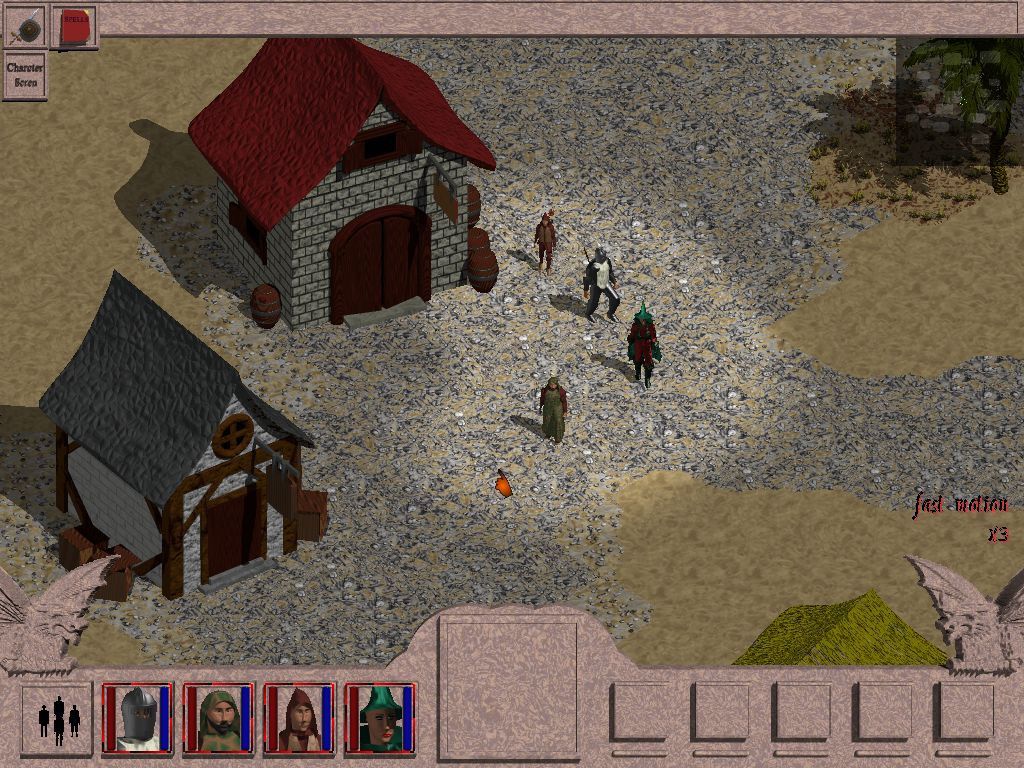
The “portals” that bookend the space are inspired by the use of the portal as a strange, diegetic mode of travel within the fantasy RPG. The “waygates” of Elden Ring, or the “dreamgates” of Hollow Knight, for example, act as both a gameplay convention and an ethereal door for travel, or access to another world. The image of the portal, for me, is at the heart of Magic Circle, because it represents not only a space beyond, but a tangible way there from here.
Isabella: I’d like to circle back to your shared background in photography, which is something I’m aware you don’t reference when you talk about your work. I’m curious to know why that is, and to what extent
you continue to relate to the practice of image making and/or photography within your practice, or more to the point, are consciously trying to upend our expectations of that medium?
Kara: Having been trained in a traditional photographic background, we both have this formal education in darkroom printing, developing, and an understanding of the camera as this physical machine that produces photographs. Having this camera-based, lens-based technical background, we then wanted to break these ideas and these notions of the image—to break away from “the photograph,” the indexicality of the image, to a place beyond the camera, out of bounds. We extended that instinct to other technologies, and, in our own ways, continued to create outside of “intended use”, and “successful” digital production; to probe digital media for holes and exploits and unexpected outputs.
Isabella: I love that you are completely rebelling against your formal, technical education. It goes back to the way we’re taught to think about digital technologies in general, that there’s a singular, correct way to use them. You are completely playing against that logic in both your process, but also within the conceptual space.
Kara: In grad school, we were making a lot of tabletop photography and constructing an image rather than documenting. We made a lot of work that could be categorized as “constructed performance,” which can be described as a performance for the lens, or the construction of tableaus for the lens. So every physical thing that we constructed became a prop in service of the image. It was all about how this was going to be perceived in being captured. And that applies to how we view sculpture now. Everything is a prop for an image. And I feel like that sentiment is not just in our work, but becomes a kind of philosophy. The artist and image theorist Hito Steyerl argues through her writings on the “poor image,” that we can’t understand our current reality without the knowledge of photography, photoshop, 3D-modeling, etc, and that our reality is “post-produced.” Clare and I as image-makers and now “prop-makers,” work under this assumption that everything will, eventually, end in an image.
Clare: I think the “Portals” are a really good example of this. When I make 3D scans, the goal is not to digitally render exact copies of the sculpture we made, or in this specific case, the beach I was at. The scanned image is not meant to duplicate reality Even from far away, they don’t look like photographs. It is more about what they could be – some aspects of the scan are a more accurate depiction of rocks, but as you get closer the failing of the technology becomes more and more apparent. For example, in the works titled “Portals” digital residue, or noise, is apparent as well as the hard line of a broken polygon of the model itself.
Isabella: As you’ve explained, Magic Circle, and your wider series of collaborative installations titled The Cloud of Unknowing, function on one level as props – or a setting or framework – through which to play and experiment with new hybrid aesthetic forms, and in particular our evolving definition of the “image” within artistic practice. However, they also exist as a physical space to empirically test, or manifest, the emerging concept of “hybridity” itself. How do you relate to and define this idea of hybridity? What draws you to these ideas, both personally or artistically, and what ideas do you draw on?
Kara: The Cloud of Unknowing and Magic Circle are useful scaffolding or containers for our creations. And these containers are informed and influenced by digital vernacular. In this case, hybridity is not just present within our work, but speaks conceptually to the way in which we live, where we find ourselves.
“Hybridity” can be described as the intermeshing or intertwining of our physical and digital realities as they’re becoming more accessible and collapsed together within our daily lives. It’s the condition in which we find ourselves.
We’re often using really sophisticated technology as found material due to this hybrid state as our constant state of being. This manifests itself in our processes, in our making, and also in our installations as this double vision, or these forms that exist across multiple spaces, and have gone through the journey of being input and output. There’s a trope in fantasy where a character revives from the dead, or comes back from a supernatural experience, essentially, the character “comes back wrong,” meaning some part of them has been irrevocably changed for better or worse. I think our works have a bit of that—that in being translated into digital space and back out again, something fundamentally changes, and that’s one of the conditions of hybridity.
Clare: And so, because we’re living in this digital-physical state, we tend towards working with video games and working with photogrammetry. It feels like the next logical move towards finding undefinable, ineffable art forms. We have so many more tools at our disposal than we are aware of, why not use them when we see them?
Definitions
Modding: Modding (from modifying) is the act of modifying hardware, software, or anything else to perform a function not originally intended by the designer, or to achieve bespoke specification or appearance. The term is often used in reference to video game modding, particularly in regard to creating new or altered content and sharing that via the web.
Speedrunning: Speedrunning is the act of playing a video game, or section of a video game, with the goal of completing it as fast as possible. Speedrunning often involves following planned routes, which may incorporate sequence breaking and exploiting glitches that allow sections to be skipped or completed more quickly than intended.
Photogrammetry: Photogrammetry is a technique that uses photographs to create 3D models of objects, structures, or spaces. It involves taking overlapping photos of an object and stitching them together using software to create a 3D model.
Queer failure: Queer failure is a term coined by writer and philosopher Jack Halberstam, who argues that failure can be a productive way of critiquing capitalism and heteronormativity. Using examples from popular culture, like Pixar animated films, Halberstam explores alternatives to individualism and conformity.
Polycam: Polycam is a 3D scanning phone application.
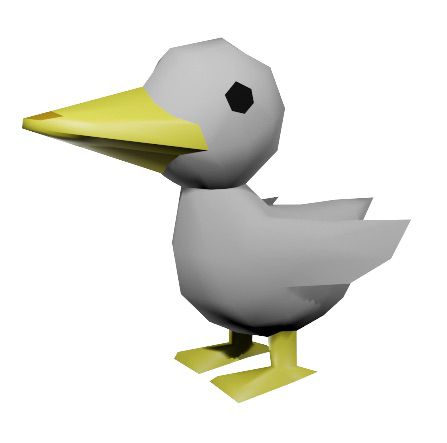
Polygons: Polygons are used in computer graphics to compose images that are three-dimensional in appearance. Polygons are built up of vertices, and are typically used as triangles. Low poly is a polygon mesh in 3D computer graphics that has a relatively small number of polygons. Models that are said to be low poly often appear blocky and simple while still maintaining the basic shape of what they are meant to represent. Low poly graphics emerged around late 2013 as a specific style, similar to earlier artistic movements where artists like Paul Cézanne tried to decompose objects into geometric shapes. The low poly style seeks to highlight the idea that the world can be represented by a composition of shapes, which makes it a self-aware style that is intentionally vague.
Unrecognizable from its source: This term borrows from the work of media theorists Jay Bolter and Richard Grusin.
Sandin Image Processor:
Glitch art and theory: The technological definition of “glitch” is a short-lived fault or break from an expected flow of operation within a digital system. Glitch art is the metaphorical, conceptual or aesthetic use of technological glitches and other resolutions within the realm of art. Glitch theory explores the social, political, and cultural dimension of glitch art aesthetics. Glitch theorists, such as Betancourt and Menkman, argue that glitch art, and the intentional imperfection inherent to it, illuminates the unseen assumptions, ideology of dialectical thinking, and role of established knowledge that shapes our engagement with the world.
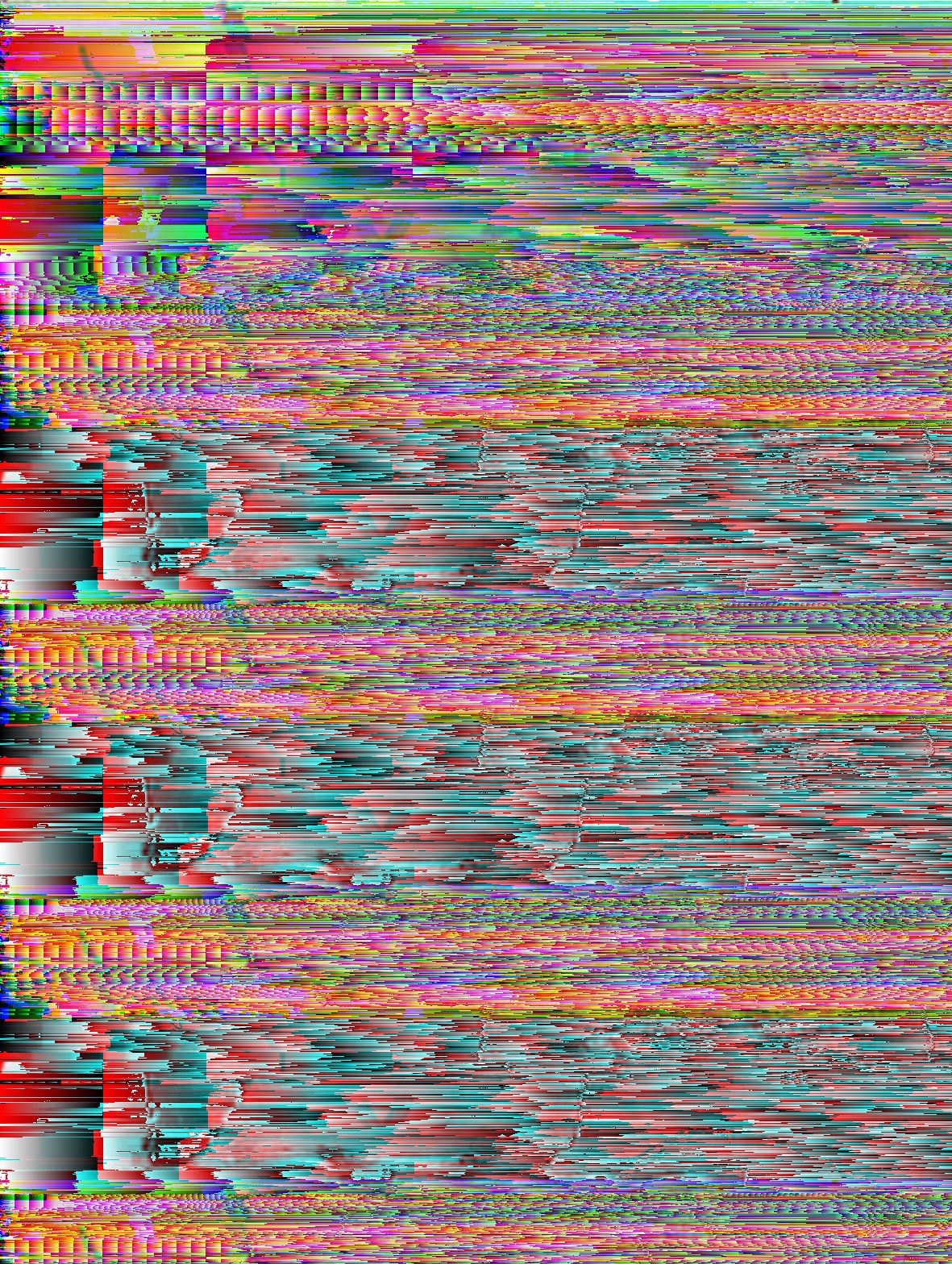
Fan Practices: A fan practice refers to the productive activities engaged in by fans, primarily those of various media properties or musical groups. These activities can include creation and editing of written works (fanfiction), computer-assisted art (fanart), videos (fanvids, fanedits) or costuming and collecting, etc. Within video game fandom, it can mean the manipulation of avatars for the creation of cinema (machinima), the alteration and overlaying of code (modding), datamining, speedrunning, and let’s-plays.
Queering: Queering is a technique of critical reading or analysis that is used to challenge heteronormativity. Emerging out of queer theory in the late 1980s, queering is a method that can be applied to literature, film, and other media. Queering initially dealt more strictly with gender and sexuality, but quickly expanded to become an umbrella term for addressing identity as well as a range of systems of oppression and identity politics.
Play: In the essay “Poetics of Play,” scholar Audrey Anable argues that video games are a unique method of engaging with and critiquing the technocultural conditions of society. In Anable’s words, video games “offer unique insights into how computers have transformed politics, emotions, sociality, and play over the last half century.” As a result, Anable and others claim that the “play” inherent to gaming becomes an important tool or methodology for interpreting the rules and structures of contemporary digital life.
Unfinished: In his essay “Unfinished Business,” media theorist Peter Lunenfeld introduced the concept of the ‘unfinished’ as an inherent feature in digital art. Lunenfeld argues that
the open structure of electronic and computational systems demands constant incremental change. As a result, digital media and art has an “open-ended” aesthetic that accepts the limitations of the inherited concept of “finished a work” and no longer attempts to achieve finitude.
RPG: RPG is an abbreviation of the term “role-playing game,” RPGs are most commonly associated with video games and tabletop games. In RPGs, players assume the roles of characters in a fictional setting and take responsibility for acting out these roles within a narrative, either through literal acting or through a process of structured decision-making regarding character development. Actions taken within many games succeed or fail according to a formal system of rules and guidelines.
Elden Ring:
Indexicality: Indexicality in photography refers to the inherent quality of a photograph to be a direct trace or imprint of the physical world. It signifies the causal relationship between the photographed object and the resulting image. The term “indexicality” was not specifically coined for photography, but is a concept within semiotics that was applied to photography and visual arts.
Poor image: Hito Steyerl’s theory of “poor images” describes images that travel through networks and lose resolution and information. Poor images are a product of the evolution and proliferation of digital media. They are low resolution, overly-edited, unruly images that revel in their own mediocrity. Steyerl situates poor images in a longer tradition of aesthetics that emphasize amateur, DIY aesthetics, and in opposition to the recent trends surrounding the fetishization of high resolution.
Portal: A gateway or entrance. Portals to the underworld are a common feature in folklore and mythology, and include gates, caves, and other entrances. The term ‘portal’ is often used in contemporary parlance to refer to a website that gathers information from various sources and presents it to users in a unified way.
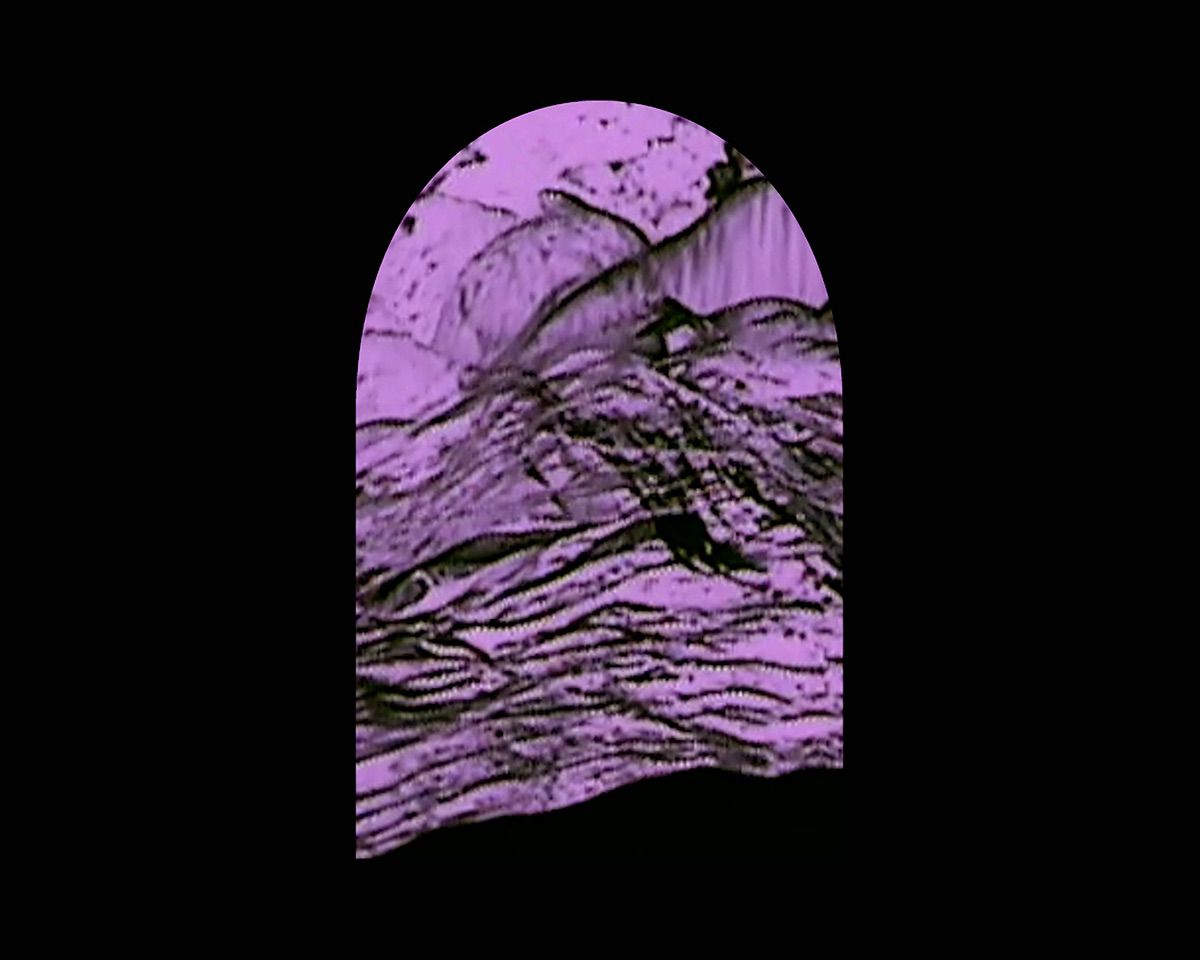
The Cloud of Unknowing: The Cloud of Unknowing is the in-progress video game by the exhibiting artists. It is a multi-level immersive RPG that considers the artificial nature of hybrid objects in our contemporary landscape.
Image: An image is a form of visual representation and is one of the most fundamental forms of art-making. The history of the image in art traces its origins to prehistoric cave paintings, where early humans depicted animals and scenes from their lives on cave walls, often believed to have ritualistic purposes. Throughout history, images in art have evolved significantly, reflecting cultural shifts, religious beliefs, and technological advancements, with notable periods like the classical Greek and Roman emphasis on idealized human forms, the medieval focus on religious iconography, the Renaissance pursuit of realism, and modern art’s exploration of abstraction and conceptual ideas.
Hybridity: Hybridity, in its most basic sense, refers to a mixture or combination of distinct forms. The term originates from biology and its contemporary uses are scattered across numerous academic disciplines, particularly anthropology and cultural studies. It is also often used to refer to technological systems that combine two or more technologies with the aim of achieving environmentally efficient systems.
The term is most frequently used within an arts context to refer to humanity’s continued immersion within a hybridized environment of reality and augmented reality, considering the proliferation of physical and digital media. For artists working with and responding to new technologies, the hybridization of physical and digital elements has become a space of exploration and deconstruction.
Magic Circle: The magic circle is a concept that can be referred to as the essence of all game design and game experience. The term originated with Johan Huizinga who coined the term in his book Homo Ludens (1938) when listing places where play happens. Huizinga stated that there was not much difference between a sacred place of religious observance and an actual playground. According to him, the courtroom, church and sports hall were all comparable – all temporary worlds within the real world, meant for special events.
Huizinga’s ideas have since been expanded upon by Katie Salen and Eric Zimmerman, who define the magic circle as the boundary between the gaming world and the actual surrounding real world. Once you step over this boundary, everything changes, including rules, norms and behavior.
Further Reading + Reference List
Books / Periodicals / Essays
Anable, Audrey. “Introduction / Issue 30: Poetics of Play.” InVisible Culture Journal, no. 30 (2019).
Bolter, Jay David, and Richard Grusin. Remediation: Understanding new media. Cambridge, Mass: MIT Press, 2003.
Davis, Erik. TechGnosis: Myth, magic, & mysticism in the age of information. Berkeley, CA: North Atlantic Books, 2015.
Halberstam, Jack. The Queer Art of Failure. Durham: Duke University Press, 2011.
Ingersoll, Alex. “Divining the Network with the Forked Twig.” Amodern, September 29, 2014. bit.ly/Ingersoll-Alex
Juul, Jesper. The Magic Circle and the Puzzle Piece. Conference Proceedings of the Philosophy of Computer Games 2008, ed. By Stephan Günzel, Michael Liebe and Dieter Mersch, Potsdam: University Press 2008, 056-067.
Lunenfeld, Peter. Digital Dialectic: New essays on new media. Cambridge: MIT Press, 2015.
Manovich, Lev. The language of new media. Cambridge: MIT Press, 2000.
Mejias, Ulises Ali. “Strategies for Disrupting Networks.” Off the Network, June 1, 2013, 81–94.
Menkman, Rosa. “Glitch Studies Manifesto.” Amodern, 2010. bit.ly/Menkman-Rosa
Ruberg, Bonnie, and Adrienne Shaw. Queer Game Studies. Minneapolis: University of Minnesota Press, 2017.
Sobchack, Vivian. Carnal thoughts embodiment and moving image culture Vivian Sobchack. Berkeley, Calif. u.a: Univ. of California Press, 2011.
Steyerl, Hito. “In Defense of the Poor Image.” E-flux Journal #10, November 2009. bit.ly/Steyerl-Hito
Steyerl, Hito. The Photographic Universe | Photography and Political Agency? with Victoria Hattam and Hito Steyerl.
bit.ly/Steyerl-Video
RPGs
Myst
Elden Ring
Dark Souls
Skyrim
Bloodborne
Diablo
Hollow Knight
Baldur’s Gate
Blasphemous
The Witness
Escape Goat II
Trine
Death’s Gambit
Darkest Dungeon
